Most people usually become acquainted with events from the past through TV/movies that are works of historical fiction. Children in school often have social studies lesson plans supplemented with films. It’s important to note that movies with historical topics are in fact just stories with literary elements such as a point-of-view, characters, dialogue, plots, etc. Filmmakers can create major factual errors in the interest of telling a better story. It’s important to recognize historical fiction in film and to analyze it as a work of fiction. I believe this is a skill that will benefit a person throughout their life. ✨
.
On that note, Sofia Coppola’s Marie Antoinette isn’t actually meant to be historically accurate. Her relationship with Louis XVIth and her personality in the movie do not match with historical accounts, but, in a way, this is done on purpose.
.
Where the movie “fails” FOR THE VIEWER WITH NO KNOWLEDGE OF THE PERIOD is in context. It is so focused on Marie Antoinette that it fails to paint a bigger picture for the viewer. 🖼 Why did the French Revolution start in the first place❓ We get a grand picture painted of the excesses of royalty 👑💸but never really get a sense of the growing turbulence in the population.
.
Sofia Coppola’s purpose in choosing to depict the story from Marie Antoinette’s perspective. Coppola specializes in coming-of-age movies, you can see this as she directed The Virgin Suicides, The Bling Ring, etc. all mostly focusing on a female teenage lead learning how to cope with being a woman and living with teenage struggles. In the sequences where Marie Antoinette is choosing her new wardrobe, for instance, among the scattered shoes on the floor you can spot a pair of Converse shoes. 👟This anachronic element is done on purpose to show that, ultimately, Marie Antoinette is a teenage girl made to grow up too fast by her society’s conventions.

Most costume designers end up being constricted by their allotted budgets and have to make compromises with the historical accuracy. This was not the case with this movie.
.
Sofia Coppola’s Marie Anotinette had a rather large budget, which allowed designer Milena Canonero the freedom to create period-accurate pieces (the inaccuracies were only added for narrative purposes not budget constrictions). This portrait is one of the most famous portraits depicting the young bride, dated around the 1770’s. This was must have been used, more than certainly, as inspiration for the two blue 👗’s she wears very early on in the movie.
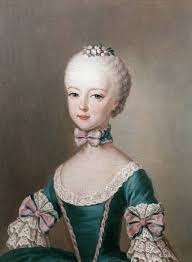
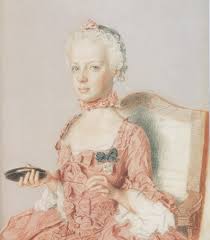
The neckline is practically identical, as is the color combination of blue and pink and the little choker. But it also takes inspiration from the Versailles’ fashion of the time and changes the placement of the bows from the sleeves and choker (as it’s in the portrait) to the stomacher.
.
This peach-colored gown in the second portrait shows up in almost identical form in the movie itself. 🎀
It’s this kind of commitment to period that makes the designs for this movie so great.
Another portrait that seems to be an influence for the costumes is this painting by Louise Élisabeth Vigée Le Brun, dated around 1783.

This depiction of the queen was, at the time, really controversial, for it showed the Queen in a very unofficial and unorthodox way. She’s wearing a chemise, a new style of softer, lighter dresses popularized by Marie Antoinette in the 1780’s and that would come to be known as Robe a la Reine.
.
The distinctive elements of this style are the white muslin fabric, the wide frills at the neckline, the large sleeves gathered at the shoulder and cuff and the colorful sash. This was the epitome of comfort back at the day, for it was worn without any kind of hoop or pannier (this was what made it so controversial in the first place).
.
This is, clearly the costume designer’s main influence behind her designs for the Trianon retire phase.
.
All of these are clearly referencing that painting; from the sheer material to the back-bows and the texture of the dress itself. This was, actually a pretty wide-spread fashion around the early 1780’s, a fashion that favored a certain return to basics and comfort after the extravaganza of the late 17th century and most of the 18th century.
 historywithhilliary.video.blog